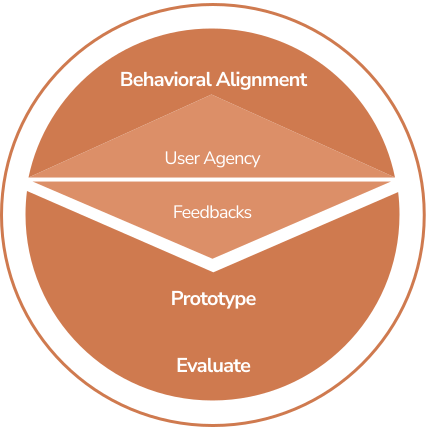
Shape
How do we make it real, and keep it relevant?
Build and refine anticipatory experiences that balance automation with control, calibrate trust, and evaluate against real user outcomes.
Behavioral Alignment
Who's in control, and when? Match the level of autonomy to the stakes, with clear override and feedback.
Autonomy Scale (1–10)
What it is · Interaction-control protocols across the levels of autonomy: from simple adjustments to advanced customisation of the system's decisions.
Why it matters · Users who can modify system behaviour as needed without losing trust: agency designed across both data and AI-output control, not left as an afterthought.
Feedback & Recovery Design
What it is · Feedback loops and recovery mechanisms that keep the user aware of system state and able to act, especially during errors and failures.
Why it matters · Meaningful, real-time feedback and accessible recovery paths, so control is preserved when things go wrong.
Prototyping
How do we build trust? Prototype personalization and the four components of trust.
Trust Calibration
What it is · Trust-building features tested across scenarios against Kore's four components of trust: competence, reliability, predictability, benevolence.
Why it matters · Trust that's calibrated, not maximised, avoiding both overtrust (complacency) and distrust (underuse).
Explanation Types
What it is · A progressive-disclosure pattern for explanations: surface (one line), detail (structured reasons), full (provenance + confidence), matched to the stakes of each decision.
Why it matters · Explanations calibrated to trust needs: terse when stakes are low, richer when the user is deciding whether to comply.
Evaluation
How do we keep it relevant? Measure against user outcomes and re-run over time. This is where AI-UX Score lives.
AI-UX Score
What it is · A respondent-backed measure of the AI experience across seven dimensions of trust and usability, run as part of ongoing evaluation.
Why it matters · A structured read on whether people actually trust the system: a benchmark you can track as behaviour drifts over time.
Interactive Evaluation
What it is · A two-layered measurement practice: A/B tests for short-term causal attribution, longitudinal cohorts for behavioural drift over weeks and months.
Why it matters · A sustained view of whether the AI is really helping, catching regressions that are invisible at the statistical-significance layer.