Imagine
What futures are possible, and how do we design for them?
Envision alternative futures and prototype ethical, explainable systems, exploring multiple plausible futures rather than predicting one.
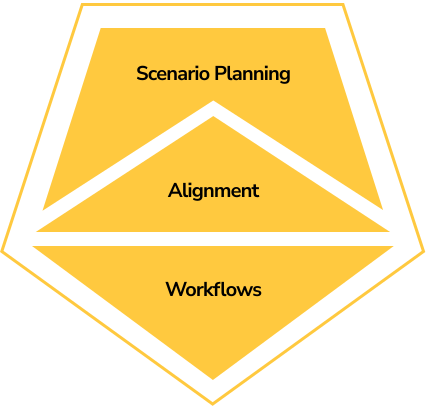
Scenario Planning
What could go wrong in each world? Build four futures from your tensions and pressure-test the design against each.
Four Futures 2×2
What it is · A 2×2 matrix built from two critical uncertainties, generating four named, vivid, contestable worlds your product must hold up in.
Why it matters · Four scenarios with a strategy per quadrant, forcing design decisions that work across futures, not just the optimistic one.
Failure vs. Error Messages
What it is · A communication pattern that separates user errors (“try this instead”) from system failures (“we made a mistake”), each with its own recovery path.
Why it matters · Recovery a user can actually follow, keeping them in control and cutting the confusion a wrong or blaming message creates.
Alignment
What path connects the future to today? Trace how the desired future reaches back into present interactions.
Day-in-the-Life (3, 5, 10 years)
What it is · A visioning and backcasting exercise: describe the user's day-in-the-life at future horizons, then reverse-engineer the journey back to a concrete first action.
Why it matters · A user-centred long-term goal made actionable: milestones from the desired future to today, so the roadmap starts from where users should be, not where they are.
Workflows
How does the system learn, decide, and explain? Architect feedback loops, autonomy, rewards, and explainability.
Feedback Loops
What it is · A dual-signal design pattern (explicit ratings plus implicit behavioural cues) specifying how the AI learns and when that learning changes behaviour.
Why it matters · A loop spec with signal type, latency, and intervention trigger, so the system's learning is deliberate rather than accidental.
Autonomy Protocols
What it is · A contextual policy built on the 10-level autonomy scale (Sheridan & Verplank): a default level plus escalation and de-escalation rules.
Why it matters · A shippable policy: how much the system takes on, when it hands up to the human, and when the user's overrides hand it back down.
Reward & Explainability
What it is · A pre-launch audit that writes the AI's reward function in plain English and maps its proxies to real user outcomes, paired with a transparent explanation of each automated decision.
Why it matters · A truthful answer to “who benefits when this metric goes up?”, exposing vanity metrics and misaligned optimisation before you ship.